
SaferWorldbyDesign: Why PFAS Substitution Is Suddenly Everyone's Problem
The Regulatory Snapshot: Europe vs. the U.S.
Europe: Going Big, Going Slow, Going Anyway
The EU is pursuing something almost nobody has tried before: regulating PFAS as an entire class of roughly 10,000 substances at once, rather than on a chemical-by-chemical basis. The proposal, which was submitted back in 2023 by Germany, the Netherlands, Denmark, Sweden, and Norway, would restrict production, use, and sale of PFAS broadly under REACH (the EU's core chemicals law).
Progress has been genuinely significant in 2026:
- In March 2026, ECHA's Committee for Risk Assessment concluded that PFAS pose a risk across the EU that justifies restriction.
- That same month, ECHA opened a public consultation on the socio-economic side of the proposal, running through late May 2026.
- The definition being used is refreshingly nerdy but important: essentially any substance containing at least one fully fluorinated carbon atom counts, meaning the restriction's reach depends on molecular structure, not brand names or marketing labels.
A final regulation isn't expected before 2027 at the earliest, so this is very much "coming, but not here yet." In the meantime, individual EU countries aren't waiting around. France's ban on PFAS in cosmetics, along with several other consumer product categories, took effect January 1, 2026. Denmark has already banned PFAS in clothing, shoes, and waterproofing products. The EU's revised Drinking Water Directive also introduced tighter monitoring requirements that kicked in this year, pushing utilities to invest in far more sensitive detection technology.
Sources: White & Case · A&O Shearman · UL Solutions · Certivo
United States: A Tug-of-War Between Federal and State
If Europe's approach is "big and slow," the U.S. picture right now is closer to "federal government pumping the brakes while states floor the accelerator." At the federal level, EPA's Comprehensive PFAS Strategy (announced May 2026) keeps the existing 4 parts-per-trillion drinking water limits for PFOA and PFOS, but proposes rescinding limits for four other PFAS compounds and extending compliance deadlines for utilities out to 2031. EPA has also delayed reporting deadlines under its TSCA PFAS reporting rule multiple times, most recently pushing the reporting window toward 2027. That's the retreat. Here's the advance: states are moving faster than ever to fill the gap. Maine and Minnesota are both pursuing near-total product bans on PFAS by 2032. At least 11 states now regulate PFAS-containing firefighting foam. New York is developing its own soil remediation standards. And in June 2026, EPA, alongside the Department of Justice, announced its first major federal settlement with a PFAS manufacturer over contamination of the Cape Fear, Delaware, and Ohio Rivers, signaling that enforcement and litigation risk hasn't gone anywhere even where rulemaking has slowed.
Sources: EPA — Key Actions on PFAS · Ballard Spahr · EPA — SDWA PFAS Rule · National Law Review
The Takeaway
Whether you sell into the EU, the U.S., or both, the direction of travel is the same: less PFAS, more scrutiny, more documentation requirements, and less patience for "we didn't know." A patchwork of state, national, and supranational rules, all moving at different speeds, is exactly the kind of environment where guessing wrong gets expensive.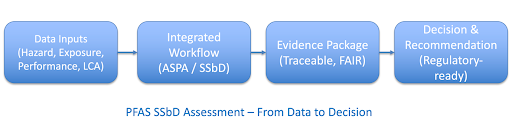 The Real Trap: Swapping One Problem for Another
Here's the part that doesn't get talked about enough. Getting rid of PFAS isn't actually the hard part: companies can and do pull specific PFAS out of formulations all the time. The hard part is replacing them with something that doesn't quietly recreate the same problem a few years later.
This has a name in regulatory circles: regrettable substitution. It's what happens when a company swaps a well-studied, restricted chemical for a lesser-known one that seems safer mostly because nobody has looked closely at it yet. History is not short on examples of substances that looked like safe replacements and later turned out to have their own baggage.
Avoiding that trap requires actually knowing things: hazard profiles, exposure pathways, how a candidate substance performs under real-world use conditions, and what its full lifecycle footprint looks like.
This is exactly the challenge that Safe and Sustainable by Design (SSbD) seeks to address: not simply replacing regulated chemicals, but identifying alternatives that are demonstrably safer, sustainable, and fit for purpose.
Why This Is So Hard to Do Well
If you've ever tried to run a substance-substitution project, you already know the drill:
- Toxicology data lives in one place, exposure data in another, and performance data with the R&D team who's three deadlines behind.
- Nobody wants to be the one who signs off on a "safer" alternative that turns out to be regrettable substitution #47.
- Every stakeholder - legal, sustainability, procurement, regulatory affairs - wants a different kind of evidence, and reconciling all of it by hand takes months.
- And regulators increasingly expect a documented, reproducible decision trail, not just a conclusion.
None of this is a data problem exactly. It's a decision-architecture problem: too many inputs, too little structure, and not enough time.
The real competitive advantage is no longer having more data than everyone else; it's having a better way to turn diverse scientific evidence into trusted decisions. That means combining human expertise with transparent, AI-assisted evidence workflows that make every substitution decision explainable, reproducible, and defensible. The “decision intelligence” goal is not automated decision-making but better-supported human decision-making.
What a Better Process Actually Looks Like
The challenge is no longer finding more data. Most organisations already have more information than they can comfortably interpret. The real challenge is transforming diverse scientific evidence into trusted decisions. That requires structured workflows that combine data, mechanistic understanding, expert knowledge, uncertainty analysis and transparent documentation in ways that allow scientists, engineers, business leaders and regulators to reach decisions they can all understand and defend.
The approach we've found actually works is treating substitution as one integrated decision rather than four separate reports that someone has to reconcile later: hazard data, exposure and toxicokinetics, real-world performance, and lifecycle/sustainability metrics, all feeding into a single structured framework rather than four disconnected memos. The output isn't "here's some data" - it's a ranked, justified shortlist of alternatives with the reasoning attached, built to hold up if a regulator or an auditor asks "why this one?"
The Bottom Line
PFAS regulation isn't a single cliff-edge deadline; it's a slow, uneven tightening happening at EU, U.S. federal, and U.S. state levels simultaneously, on different timelines, with different definitions and thresholds. That messiness is precisely why "quietly swap it for something similar and hope" is a riskier strategy in 2026 than it was five years ago.
If you're in the middle of a substitution decision and want to compare notes on how to structure the evidence behind it, we're always happy to talk. Curious how this applies to your own PFAS challenge? The companies that succeed over the next decade will not simply substitute chemicals more quickly. They will build trusted evidence systems that allow safer innovation to become a competitive advantage. We're always happy to talk through a real case.


