SaferSkin
SaferSkin™ is an integrated solution that supports the determination of key safety properties of skin, including irritation, tolerance, penetration, metabolism, and sensitisation. SaferSkin™ integrates in silico and in vitro methods and services, supported by a harmonised data infrastructure and an expert consulting team. As part of our solutions, we developed the SaferSkin application, which is an integrative skin sensitisation assessment tool.
- About
- Regulatory Submission Support
- Centralized Data & Evidence Hub
- Centralized Data & Evidence Hub
- Partner contribution
- Methods & Scientific Foundation
- NAM Adoption Guidance / Model Comparison
- Platforms (SaferSkin | SmartSafety)
- Case Studies
- Skin Sensitisation - a SaferWorldbyDesign Case Study
- Required/Additional assays for skin sensitisation risk assessment of chemicals and materials
- Speak With an Expert

Solve Skin Safety Decisions with Confidence
Our SaferSkin solution area supports toxicology and regulatory teams in advancing skin safety assessment projects, from addressing data gaps and selecting models through to regulatory-ready assessments.
We help you integrate in vitro results, in silico predictions, literature evidence, and internal data into a single, defensible evaluation for use in submissions and safety decisions.
Whether you are preparing an ongoing submission, comparing NAM strategies and models, or strengthening an ingredient justification, our SaferSkin experts work with you to deliver clear, actionable outcomes, not just analysis. Engagements yield clear assessment reports, integrated evidence summaries, and practical recommendations to support regulatory decisions.
Deliver Regulatory Work Faster and More Confidently
Our SaferSkin team supports:
- Generating regulatory-ready assessments
- Identifying and closing ingredient data gaps
- Comparing OECD-defined approaches and NAM strategies
- Integrating multiple data sources into a single evidence package
- Supporting active regulatory submissions under real timelines
- Our work aligns with established regulatory frameworks and defined approaches, ensuring transparency and defensibility
Our approach helps reduce uncertainty, accelerate decision-making, and improve confidence in safety justifications. If you are currently working toward a submission deadline or facing uncertainty in your strategy, our team can quickly help you determine the most effective path forward.
Expert Consulting Powered by Integrated Platforms
Our SaferSkin consulting is supported by our digital platforms, including the SaferSkin App and SmartSafety, which enable structured data integration, transparent model comparison, and reproducible regulatory documentation. These tools enhance project delivery, but our primary focus is helping your team achieve regulatory outcomes efficiently and defensibly.
Regulatory Framework & Scientific Intelligence
SaferWorldByDesign supports companies with modern product safety assessment, regulatory compliance, and scientific decision-making. We combine toxicological data, OECD-aligned methodologies, exposure assessment workflows, and modern NAMs-based approaches to help organisations manage safety assessments more efficiently.
Our platform is designed to support regulatory, toxicology, and product stewardship teams by improving consistency across assessments, reducing fragmented manual workflows, and helping companies adapt to evolving global regulatory requirements and international safety submission requirements.
To ensure scientific integrity and regulatory alignment, we apply our services under the latest internationally recognised guidelines and accepted methodologies. This includes support for modern scientific frameworks such as Defined Approaches (DA), Integrated Approaches to Testing and Assessment (IATA), Weight of Evidence (WoE) evaluations, and Next Generation Risk Assessment (NGRA) strategies.
In addition to hazard identification, our systems support exposure-driven safety assessment workflows including Margin of Safety (MoS) calculations, ingredient hazard profiling, consumer exposure assessment, and integrated toxicological review processes. We also support environmental and sustainability-focused assessment strategies, including biodegradation and safer chemistry evaluation workflows.
Standardised Regulatory Reporting
Our platform is designed to make it significantly easier for organisations to produce high volumes of consistent, standardised safety and regulatory assessment reports without sacrificing scientific quality. By centralising data, automating key assessment workflows, and integrating OECD-aligned methodologies, we help teams generate reports that are efficient to produce, scientifically defensible, and capable of standing up to regulatory and scientific scrutiny across global markets. Example OECD-Aligned Assessment Methods:
Skin Sensitisation
- OECD Guideline No. 497 — Defined Approaches for Skin Sensitisation
- OECD Test Guideline No. 442C — In Chemico Skin Sensitisation
- OECD Test Guideline No. 442D — In Vitro Skin Sensitisation
- OECD Test Guideline No. 442E — In Vitro Skin Sensitisation
Skin Irritation
- OECD TG 439
Skin Permeation
- OECD TG 428
Phototoxicity
- OECD TG 432
- OECD TG 498
Eye Irritation
- OECD TG 437
- OECD TG 438
- OECD TG 492
Through our integrated approach, SaferWorldByDesign centralises and curates safety and background data within a structured system, applying advanced computational methods including industry-standard and OECD Defined Approaches (DA). This enables robust model comparison, prediction, and evidence generation to support safer, more sustainable product development.
What We Provide
- Expert consulting to support regulatory navigation and safety assessment strategy
- Formulation and ingredient modelling, testing, and integrated safety evaluation
- Study design support, scientific consulting, and regulatory reporting for global submissions
- Tiered in silico and in vitro modelling strategies for skin irritation, penetration, and sensitisation
- In vitro skin sensitisation assays performed in line with OECD guidelines and GLP standards (DPRA, KeratinoSens™, h-CLAT)
- In silico modelling using defined approaches aligned with current industry best practices
- Advanced omics-based testing of ingredients and formulations
- Evaluation of advanced materials, including nanomaterials and complex ingredient systems
- High-quality harmonised data management and provenance tracking supported by EdelweissData™
Partner contribution
Together with our partners, we serve you with up-to-date in vitro assays, computational toxicology and PBPK methods, consumer testing, and regulatory toxicology assessments. Our mission and expertise is to ensure consumer safety by identifying potential dangers in your chemical formulations and evaluating the safety of your finished products.
We will provide step-by-step assistance for your projects in cosmetic and pharmaceutical development – while maintaining full compliance with all regulatory requirements. At your disposal is a diverse portfolio of assays and methods, ranging from the well-established to the most cutting-edge.
All techniques meet the stringent criteria of modern science and are performed to the highest professional standard. We are devoted to providing an excellent, transparent, and personalised service.
The partner contribution includes:
PKDERM
PKDERM is a French company which was founded in 2018. It offers a wide range of the newest in vitro assays and models for skin safety assessment. Their focus lies on products applied in the fields of cosmetics, dermatology, pharmacy, chemicals, agro/petrochemicals, and medical devices.
> Read more
SenzaGen
SenzaGen is a Swedish biotech company that provides state-of-the-art non-animal tests for assessing a substance’s allergenicity. The GARD® test method combines genomic data from human cells with machine learning for a unique capability to identify and analyse whether a chemical could cause allergic reactions on the skin or in the respiratory tract.
> Read more
Curio Biotech
Founded in 2017, Curio Biotech Ltd is a GLP-ready Swiss Contract Research Organization (CRO) located at BioArk (biotech park), Visp, Switzerland. It provides in vitro testing services to cosmetic, pharma (small and large molecules), and diagnostic industries using proprietary culture media and primary human cell-based 3D co-culture models. In vitro services focus on basic research, drug discovery, toxicity, and pharmacology in the areas of dermatology, immuno-oncology, and regenerative medicine. Furthermore, Curio Biotech offers a variety of batch/lot release tests like potency tests for the bio-pharma industry, biocompatibility tests, and other regulatory OECD tests.
Biopredic
Biopredic International is a French privately-owned biotechnology company founded in 1993. Biopredic’s expertise was initially based on primary hepatocyte cryo-preservation and quickly grew to encompass the isolation, production, and distribution of fresh and frozen human and animal biological products, including tissues, primary cells, cell lines, and reagents.
> Read more
Eurosafe
Eurosafe is a GLP-certified (A level) Contract Research Organisation (CRO), specialised in the testing of human and animal pharmaceutical products, cosmetics (ingredients and finished goods), food supplements, medical devices and biocides. Eurosafe provides state-of-the-art in-vitro ADME tests for chemical compounds, safety tests, in-vivo efficacy and tolerance studies, toxicological expertise as well as consulting services on the European regulations. Eurosafe is one unique CRO that covers several services organized around 3 specialties: 1. In vitro assays. 2. Tests on volunteers. 3. Toxicological expertise and regulations.
> Read more
React4Life
React4life is an Italian biotech company founded in 2016 after more than 15 years of R&D by Silvia Scaglione and Maurizio Aiello, together with a multidisciplinary team of experts, with the ambition to turn the promise of biomedical research into concrete benefits for society. Scientists can finally rely on a new enabling technology to recapitulate human biology in the lab: MIVO® (Multi In Vitro Organ), the next generation of organ-on-a-chip. This cutting-edge microphysiological system enables researchers to overcome the limits of current in vitro assays and animal models. It improves the reliability and predictivity of several applications: pharmaceutical drug-testing, personalized medicine, novel immuno-oncology therapies, cosmetics, dermatology, and nutraceuticals.
> Read more
EdelweissConnect
Edelweiss Connect (EwC) - as the provider of this SaferWorldbyDesign platform - offers the expertise and experience to initiate, coordinate, and manage large collaborative research projects, with partners from industry, government, and academia. Our goal is to incubate high-impact products, services, and solutions at the forefront of innovation, with sustainability and responsibility.
> Read more
KREATiS
KREATiS is a unique organisation offering you in silico ecotoxicology, mammalian toxicology, and physical chemistry predictions to screen the hazards of your substance to complete your regulatory dossiers or boost your R&D in the most time and cost-efficient way possible using:
► Our home-grown, high-accuracy QSAR models in the form of iSafeRat® Toolbox
► A comprehensive choice of third-party software to fill the remaining datagaps that iSafeRat® does not cover
> Read more
Methods & Scientific Foundation
In Silico Modelling
Our in silico workflows are anchored in Adverse Outcome Pathways (AOPs) and leverage SaferSkin™ datasets to support model development, comparison, and prediction. We apply machine learning and QSAR methodologies to build both reference and customised models, including implementations of leading Defined Approaches used across industry.
For skin sensitisation, SaferSkin™ enables structured comparison of established industry models developed by organisations such as P&G, BASF, Givaudan, and Shiseido, providing transparent and reproducible assessment outputs.
In Vitro Approaches
Our laboratory capabilities include a broad portfolio of in vitro assays ranging from established regulatory methods to advanced mechanistic studies, guided by computational modelling. These include evaluation of dermal absorption, skin penetration, and chemical diffusion across skin models to support exposure assessment. Where appropriate, transcriptomics-based approaches are used to reduce uncertainty through mechanistic gene signature analysis, improving the interpretation of assay outcomes.
AI & Machine Learning
We develop and validate QSAR and machine learning models, including customised solutions tailored to specific customer datasets and use cases. Our AI capabilities also support structured information extraction from scientific literature and unstructured data sources, enabling integration into EdelweissData™ environments.
Data Management
EdelweissData™ provides a structured data foundation for harmonised safety information, ensuring completeness, traceability, and regulatory-grade provenance. All datasets, metadata, and workflows are stored as reproducible in silico protocols, enabling consistent reuse and auditability. Secure customer data environments can be provided through premium cloud-based deployments, supporting confidential regulatory and product development workflows.
NAM Adoption Guidance: Turning New Approach Methodologies into operational decision workflows
Overview
NAM Adoption Guidance supports organizations in transitioning from traditional toxicology approaches to NAM-based safety assessment by designing workflows that are usable, scalable, and aligned with regulatory expectations.
What it solves
Many organizations face the same gap:
- NAMs are available but not integrated
- Uncertainty on how to apply them in practice
- Lack of internal workflows and decision frameworks
This results in NAMs remaining experimental rather than operational.
What we do
- Define strategy: Identify where NAMs fit within your product development and safety assessment processes
- Design workflows: Build Integrated Approaches to Testing and Assessment, combining in silico and in vitro data
- Enable implementation: Align tools, data, and internal processes to support consistent use
- Support regulatory alignment: Translate outputs into formats suitable for regulatory review and submission
Key principles
- Fit-for-purpose approaches
- Tiered testing strategies
- Weight-of-evidence decision-making
- Alignment with NGRA and SSbD frameworks
Outputs
- Defined assessment workflows
- Decision frameworks for specific use cases
- Structured evidence ready for internal or regulatory use
Where it can be used
- Transition to NGRA
- Implementation of SSbD strategies
- Internal capability building
- Regulatory modernization efforts
NAM Adoption Guidance is a starting point for organizations aiming to move from exploration of NAMs to practical, decision-oriented use.
- → Start with a pilot use case to implement NAM-based workflows in your organization. Contact us now.
SmartSafety™: Data-driven safety assessment and risk evaluation at scale
Overview
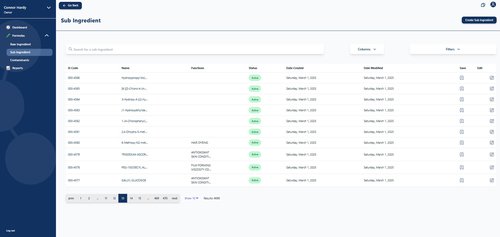
SmartSafety™ is a centralized system for managing data, performing safety calculations, and generating structured outputs to support quantitative risk assessment and regulatory workflows. It serves as the operational layer connecting data, models, and decision-making.
What it solves
Safety assessment workflows are often:
- Distributed across spreadsheets and disconnected tools
- Difficult to scale across portfolios
- Lacking traceability and consistency
SmartSafety™ consolidates these processes into a single, structured environment.
Key capabilities
- Centralized data management
- Ingredients, formulations, exposure scenarios
- Automated calculations
- Margin of Safety, exposure estimates, risk metrics
- Workflow standardization
- Consistent evaluation across products and teams
- Global regulatory coverage
- Structured outputs for internal use and regulatory submissions
Outputs
- Quantitative risk assessment results
- Standardized safety reports
- Traceable data and calculation history
Where it can be used
- Portfolio-level safety assessment
- Regulatory compliance workflows
- Product development and reformulation
- Data harmonization across teams
SmartSafety™ is the execution layer that enables scalable, repeatable safety assessment and supports integration of NAM-based approaches into routine workflows.
The SaferSkin™ application for integrated skin sensitisation assessment
- (Explore the SaferSkin2.0 Manual)
- (Explore the SaferSkin application here)
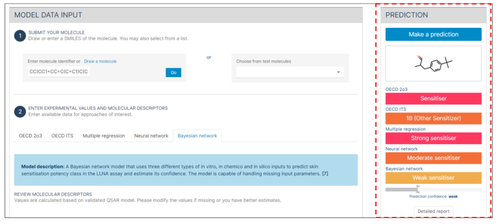
The SaferSkin™ Skin Sensitization App is a dedicated decision-support application within the SaferSkin ecosystem, designed to evaluate skin sensitization potential by combining in silico models, in vitro data, and defined approaches into a single, structured workflow. It translates complex methodologies such as OECD TG 497 into practical, reproducible assessments that support both internal decision-making and regulatory use.
What it solves
Skin sensitization assessment is often:
- Fragmented across tools and datasets
- Dependent on expert interpretation
- Difficult to standardize
- Challenging to navigate due to the wide range of available approaches, including in vitro, in silico, OECD-validated and non-validated models
SaferSkin™ addresses this by providing a consistent and transparent framework for integrating evidence, comparing approaches, and generating clear, defensible conclusions.
- The SaferSkin application is a web application, which is used for predicting ingredient’s potential to cause skin sensitisation, without animal testing.
- The application integrates safety assessment strategies for skin sensitisation.
- It combines the top three approaches for accurate predictions of skin sensitisation.
- The application applies state-of-the-art science to workflows over the entire discovery and development funnel, to regulatory acceptance and registration.
Check the science behind the app > here.
The app can be used for
- Hazard identification, classification, and labeling under the Globally Harmonised System of Classification and Labelling of Chemicals (GHS) scheme (UN 2013).
- Quantitative risk assessment (QRA) especially when combined with in vivo evidence on analogs.
- Development of an efficient testing strategy, as a decision strategy tool.
Main features
- Comparison of 3 approaches: Bayesian Network, ‘2 out of 3 weight of evidence’, multiple regression
- Category prediction with confidence levels
- Simple to use interface
- Single compound input submission - entered as SMILES or drawn
- Physical properties calculated
- LLNA pEC3 & EC3 values from 50-90th percentile confidence
Contact us to set up your SmartSafety or SaferSkin account.
Skin Sensitisation - a SWBD Case Study
SaferSkin™ enables structured comparison of established industry models developed by organisations such as P&G, BASF, Givaudan, and Shiseido, providing transparent and reproducible assessment outputs. Together with our partners, we have built a broad multi-model comparison environment, bringing together a wide range of validated approaches to support consistent, evidence-based evaluation of skin sensitisation risk.
Integrated Skin Sensitization Assessment Using Consensus Modelling and Tiered New Approach Methodology
The transition toward animal-free safety assessment of chemicals has accelerated the development of New Approach Methodologies (NAMs) for predicting skin sensitization. However, individual in silico models and experimental NAM assays frequently produce inconsistent or contradictory results, limiting their reliability when used in isolation. To address this challenge, we present a tiered integrated assessment framework implemented through the open source SaferSkin application, which enables systematic comparison and integration of multiple predictive models and experimental data within a transparent weight-of-evidence workflow.
In this case study, a diverse set of 21 reference compounds was evaluated using a battery of in silico approaches, including the OECD QSAR Toolbox, VEGA, CASE Ultra and additional machine-learning models implemented within SaferSkin.
SaferSkin Workflow - An example
Our solutions are based on authority guidelines which define the workflow during assessment to guarantee data integrity. The SaferSkin (OECD TG 497) decision tree serves as an example of such a workflow for skin safety risk assessment. It is well described in the guideline and includes the results of three standardised in vitro methods «DPRA», «KeratinoSensTM» and «h-CLAT». Each assay is specific for a molecular key event leading to skin sensitisation. Two out of the three assays have to give a clear result, otherwise the results are considered inconclusive and further data has to be included for evaluation.
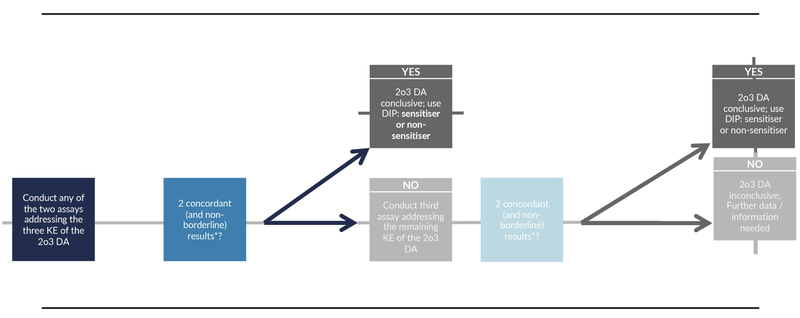
Note: Borderline results are determined based on workflows given in Annex 1 of the OECD TG 497 guideline:
«The use of information elements is dictated by the limitations as found in the respective test guidelines (TG 442C, Appendix 1; TG 442D, Appendix 1A; TG 442E, Annex 1). For example, in case a negative h-CLAT result is obtained for a chemical with Log P > 3.5 (according to the limitation described in TG 442E (4)), a 2o3 DA prediction can only be made if the outcomes of the other two test methods composing the 2o3 DA are concordant and are non-borderline.»
Required assays for skin sensitisation risk assessment of chemicals and materials
The evaluation of chemicals and materials as potential skin sensitisers is well described and regulated by the OECD 497 guidance on skin sensitisation. Thereby, three in vitro assays are described for three of the four different molecular key events leading to Allergic Contact Dermatitis (ACD) which is the adverse outcome of skin sensitisation. The first Key Event (KE) or Molecular Initiating Event (MIE) describes the covalent binding of the test substance to cysteines and lysins of skin proteins that can be measured by HPLC analysis. The DPRA assay is regulated by the OECD 442C guidance. The second KE describes the activation of keratinocytes, which constitute the main cell type in skin tissue. This KE can be evaluated by the KeratinosensTM assay, which evaluates the gene expression profile by luciferase analysis of the test cells. The KeratinosensTM assay is regulated by the OECD 442D guidance. The third KE describes the activation of dendritic cells that can be measured by the h-CLAT assay, where antibodies against CD54 and CD86 are used to measure their expression level by flow cytometry. The h-CLAT assay is regulated by the OECD 442E guidance. The three KEs lead to ACD by the activation of T-cells.
The OECD regulations demand the three assays, DPRA, KeratinosensTM, and h-CLAT to be conducted in a two-out-of-three approach. This means that two out of the three assays need to give a clear and non-contradicting result on the chemical either as skin sensitiser or skin non-sensitiser.
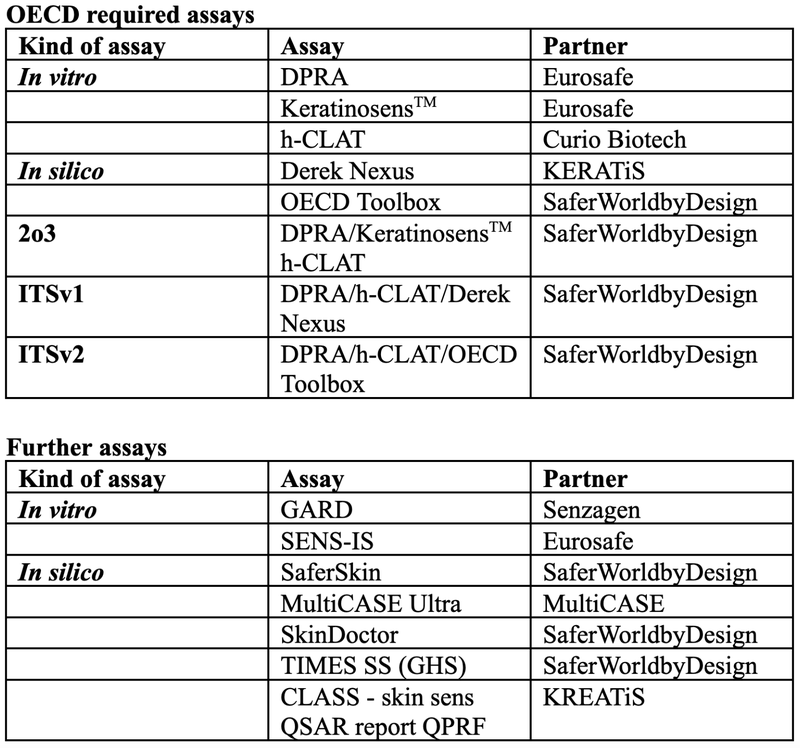
As a second point, the OECD 497 further demands that the DPRA and h-CLAT results have to be taken and integrated with an in silico QSAR approach. This in silico toolbox can either be Derek Nexus which is considered as Integrated Test Strategy version 1 (ITSv1) or the OECD QSAR Toolbox which is considered as Integrated Test Strategy version 2 (ITSv2). Please find an overview of the OECD-regulated risk assessment approach on skin sensitization in Table 1
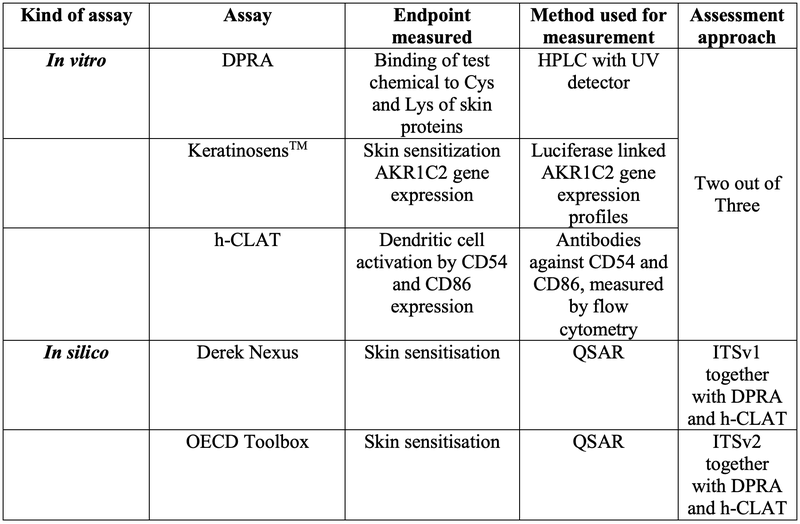
Table 1: The defined risk assessment approach for skin sensitization by the OECD 497 guideline. DPRA, KeratinosensTM, and h-CLAT have to be conducted and at least two out of the three assays have to give a clear result on skin sensitization. Furthermore, DPRA and h-CLAT have to be integrated either with Derek Nexus QSAR or OECD Toolbox QSAR modeling.
Further assays for integrated skin sensitisation risk assessment
Beside the required assays described by the OECD, further in vitro and in silico assays can be used to strengthen the weight of evidence and to underline predictive outcomes. Possible further tools include:
In vitro assays
- The Genomic Allergen Rapid Detection (GARD) assay which is based on the Nanostring nCounter technology, which enables the assessment of up to 800 genes or 228 gene fusions in twelve samples in a single assay. With a Support Vector Machine (SVM) model, chemicals are classified into category 1A (strong sensitisers) or 1B (other sensitisers). The assay measures dendritic cell activation and hence it can be used for KE3.
- The SENS-IS assay, which is a patented human episkin model assay which allows the testing of chemicals based on the analysis of the expression from a large consortium of different genes. The assay is robust, easily transferable, has high predictability and is reproducible. The assay measures keratinocyte activation and hence can be used for KE2 to underline the KeratinoSensTM results. The assay is one of the new approach methods for evaluating skin sensitisation potential of ingredients and formulations. It is based on the measurement of gene expression of 61 skin irritation and sensitisation-related genes in the human 3D reconstructed epidermis model (Episkin®) upon exposure to the tested sample. Expression of these genes is quantified by a widely used RT/qPCR technique. Based on the number of significantly induced genes, the tested sample can be classified as skin irritant or skin sensitiser. Thereby, the category 1B is further divided into weak (50% compound concentration) and moderate (10% compound concentration) outcomes and 1A is further divided into strong (1% compound concentration) and extreme (0.1% compound concentration) outcomes.20 With this, we have a strong and valuable predictive tool which we can use as an additional approach for skin sensitisation risk assessment.
In silico Assays
- SaferSkin, our computational skin characterisation comparison tool developed at SaferWorldbyDesign, includes OECD methods, Bayesian network, and multiple regression models to predict the skin sensitisation of chemicals and materials.
- The TIMES SS (GHS) model was developed by the Laboratory of mathematical chemistry in Bulgaria and is a Skin Metabolic (SM) simulator based on empirical and theoretical knowledge. It considers non-enzymatic transformations, enzyme-mediated reactions, and Protein Binding Reactions (PBR).
- The SkinDoctor application is an in silico tool which is a random forest model for binary and ternary classification of sensitisers versus non-sensitisers.
- MultiCASE CASE Ultra Toolbox is a QSAR software for modelling and predicting toxicity of chemicals for different types of applications. In our study, we used the toolbox that was developed for predicting skin sensitisation. Besides skin sensitisation, the tool provides predictions for ten models in total, including eye Draize, eye irritation, LLNA CAT2, LLNA CAT3, LLNA CAT4, Skin carcinogenicity, Skin corrosion, Skin irritation, Skin SENS LLNA, and Skin SENS non LLNA.
Figure 2 gives an overview of all the assays that are used for skin sensitisation risk assessment at SaferWorldbyDesign
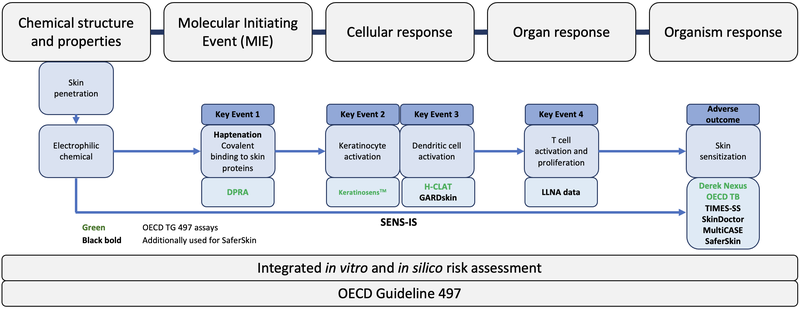
Figure 2: Overview of the OECD assays (green) and the additional assays which are offered by SaferWorldbyDesign (bold black) in relation to the measured Key Event (KE).
SaferSkin sensitisation packages
At SaferWorldbyDesign, we provide you with the OECD-required assays that you need to evaluate your compounds and materials for skin sensitization.